Victory Day
Pakistani forces surrender in Dhaka; Bangladesh becomes independent.
Dhaka surrounded
By mid-December 1971, Indian forces and the Mukti Bahini had closed in on Dhaka from several directions. Pakistan's air force in the east had been grounded and its ports blockaded. Its troops, spread thin along the borders to fight the guerrillas, could not defend the capital. The Indian Army issued an ultimatum to surrender.
The afternoon of 16 December
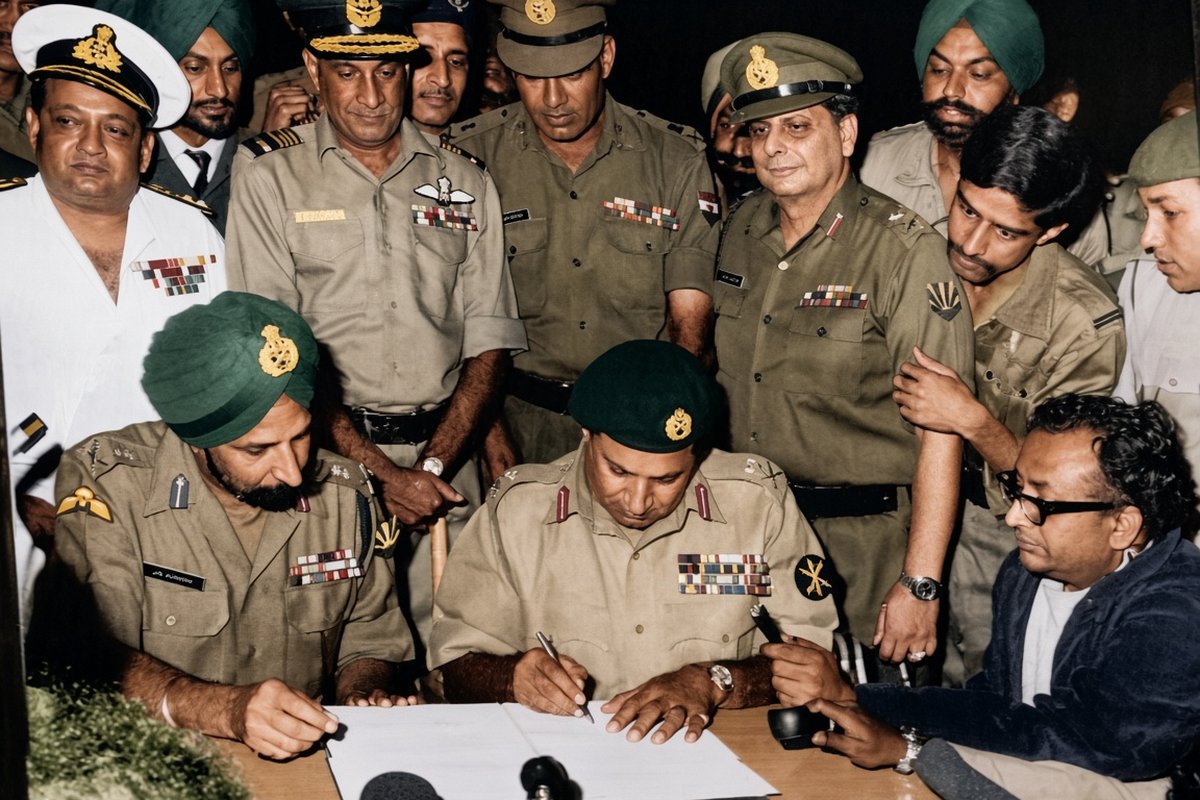
On 16 December 1971, at the Ramna Race Course in Dhaka, the same ground where Sheikh Mujibur Rahman had spoken on 7 March, Lieutenant General A. A. K. Niazi, commander of Pakistan's Eastern Command, signed the Instrument of Surrender. He surrendered to Lieutenant General Jagjit Singh Aurora of the Indian Army, joint commander of the Indian and Bangladesh forces. Group Captain A. K. Khandker represented the Provisional Government of Bangladesh. Crowds gathered at the race course and broke into celebration.
About 93,000 Pakistani personnel became prisoners of war, the largest surrender of its kind since the Second World War. Fighting on the western front ended the next day.
A nation, finally
After nine months of war, the genocide was over and East Pakistan was gone. In its place stood the People's Republic of Bangladesh. On 22 December, the Mujibnagar government returned from exile to Dhaka. Sheikh Mujibur Rahman, still a prisoner in West Pakistan, was later released and came home to the country that had been declared in his name.
The cost had been immense: lives lost in the hundreds of thousands or more, women subjected to systematic sexual violence, some ten million refugees, and cities and villages destroyed. Victory Day carries all of that.
How Bangladesh remembers
16 December is Bijoy Dibosh, Victory Day, a national holiday in Bangladesh. It has been celebrated since 1972, with a military parade in Dhaka, flags across the streets, songs on radio and television, and tributes at the National Martyrs' Memorial at Savar. In India, the same day is marked as Vijay Diwas.
Why it matters
Everything on this timeline leads here: the partition that made East Bengal part of Pakistan, the students of 1952, the votes of 1954 and 1970, the Six Points, the speech of 7 March, the night of 25 March and the long months of resistance. On 16 December 1971, the people of Bangladesh had their own country.
Thanks and sources
Thank you to Wikipedia and its volunteer editors for the information on this page. What you read here is our own summary, based on the Wikipedia articles below. Wikipedia text is shared under the Creative Commons Attribution-ShareAlike 4.0 licence (CC BY-SA 4.0).