United Front electoral victory
East Bengal rejects Muslim League rule.
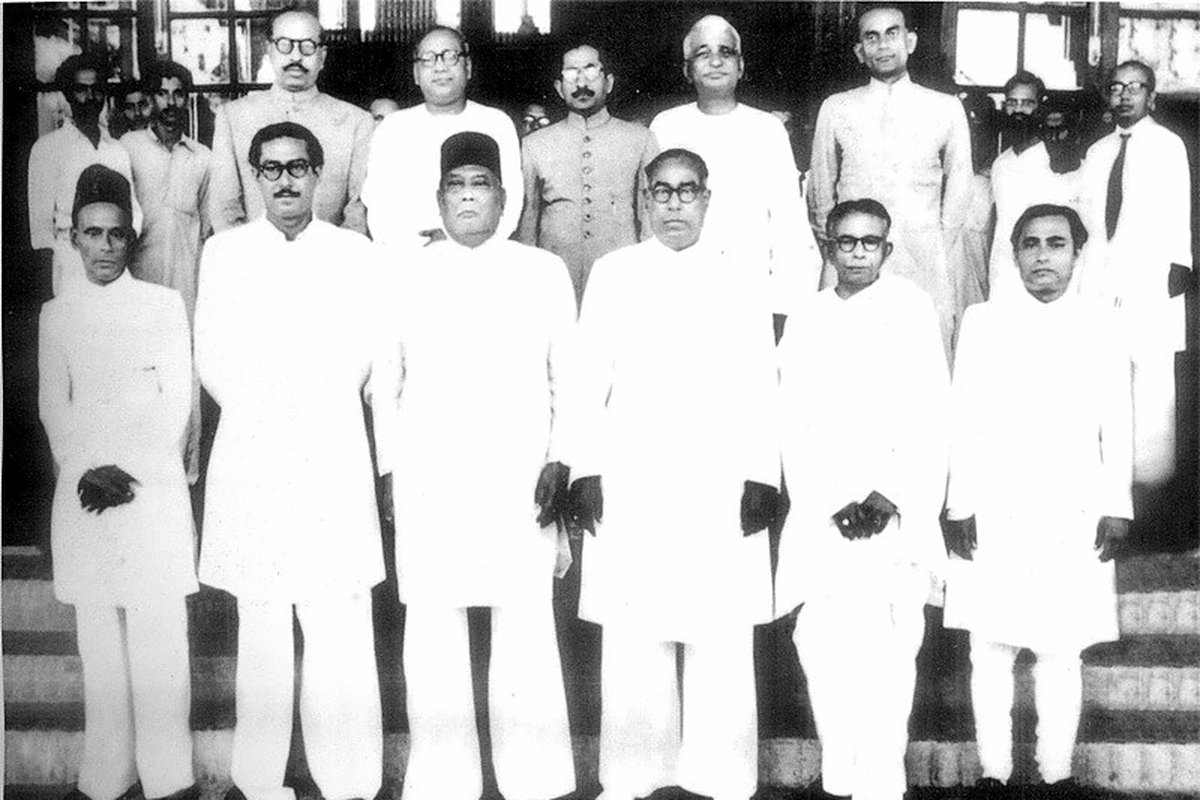
A coalition of the discontented
By the early 1950s, the Muslim League, the party that had created Pakistan, was losing East Bengal. Its provincial government had cracked down on the language protests, and many people felt their everyday problems were being ignored.
On 14 November 1953, several opposition parties joined together as the United Front. Its leaders were some of the best-known figures in Bengali politics: A. K. Fazlul Huq, Huseyn Shaheed Suhrawardy, Maulana Bhashani and Mahmud Ali. The Awami Muslim League, founded in 1949, was its largest member.
The Front campaigned on a Twenty-One Point programme. The first point was to recognize Bangla as one of Pakistan's state languages. Others called for land reform, fair prices for jute farmers, free primary education and more self-rule for the province.
March 1954: a landslide
East Bengal voted between 8 and 12 March 1954, in its first provincial election since independence. The United Front won 223 seats. The Muslim League was left with only a handful, and its chief minister, Nurul Amin, lost his own seat to a 27-year-old former student leader, Khaleque Nawaz Khan. Every Muslim League minister was defeated.
Fazlul Huq became chief minister. Younger leaders, among them Sheikh Mujibur Rahman, rose to prominence in the new provincial government, and it ordered the founding of the Bangla Academy in Dhaka.
Dismissed within weeks
The victory did not last. On 30 May 1954, after deadly labour clashes at the Adamjee Jute Mills and accusations against the new government, the central government dismissed the United Front ministry, placed Fazlul Huq under house arrest and put East Bengal under direct rule from the centre. Hundreds of United Front workers were jailed.
Why it mattered
The vote showed, beyond doubt, what East Bengal wanted: its own leaders, its own language, and a fair share of power. The dismissal showed how far the central government would go to stop that. Wikipedia describes the overthrow of the United Front as a key turning point in Bengali grievances. Soon after, the One Unit scheme merged all of West Pakistan into a single province, a move widely seen in the east as a way to cancel out its larger population.
Thanks and sources
Thank you to Wikipedia and its volunteer editors for the information on this page. What you read here is our own summary, based on the Wikipedia articles below. Wikipedia text is shared under the Creative Commons Attribution-ShareAlike 4.0 licence (CC BY-SA 4.0).
- United Front (East Pakistan)
- 1954 East Bengal Legislative Assembly election
- Bangladesh Liberation War (Political differences section)