Mujibnagar Government
Bangladesh's provisional government takes oath at Baidyanathtala, renamed Mujibnagar.
Leaders scattered, a leader in prison
After the crackdown of 25 March, the Awami League's leaders were scattered. Sheikh Mujibur Rahman had been arrested and taken to West Pakistan. Others hid, or slipped across the border into India, often without knowing where their colleagues were.
Tajuddin Ahmad, the party's general secretary, crossed into India with the lawyer and elected member M. Amir-ul Islam on 30 March. In Delhi, in early April, he met India's prime minister, Indira Gandhi. He told her that a government of Bangladesh had been formed, with Sheikh Mujib as president and himself as prime minister. From those meetings came two decisions that would shape the war: India would open its borders to refugees, and the Bangladesh government could work from Indian soil.
Bringing a government together
Back in Kolkata, not everyone accepted Tajuddin's leadership at first, and some younger leaders wanted a revolutionary council instead of a cabinet. After discussion, most agreed that a lawful government was needed. On 10 April, Tajuddin and others set off in an old borrowed aircraft, landing at small airstrips along the border to find the missing ministers. Around the same time, Tajuddin spoke to the nation on the radio and formally recognized the Bengali forces already fighting.
The Proclamation of Independence that founded the government is dated 10 April 1971. Drafted by Amir-ul Islam, it declared Bangladesh a people's republic built on equality, human dignity and social justice, confirmed Sheikh Mujib's declaration of independence of 26 March, and turned the Bengali members elected in 1970 into a Constituent Assembly. Until Bangladesh adopted its constitution in 1972, the proclamation served as its founding law.
17 April 1971: an oath under the mango trees
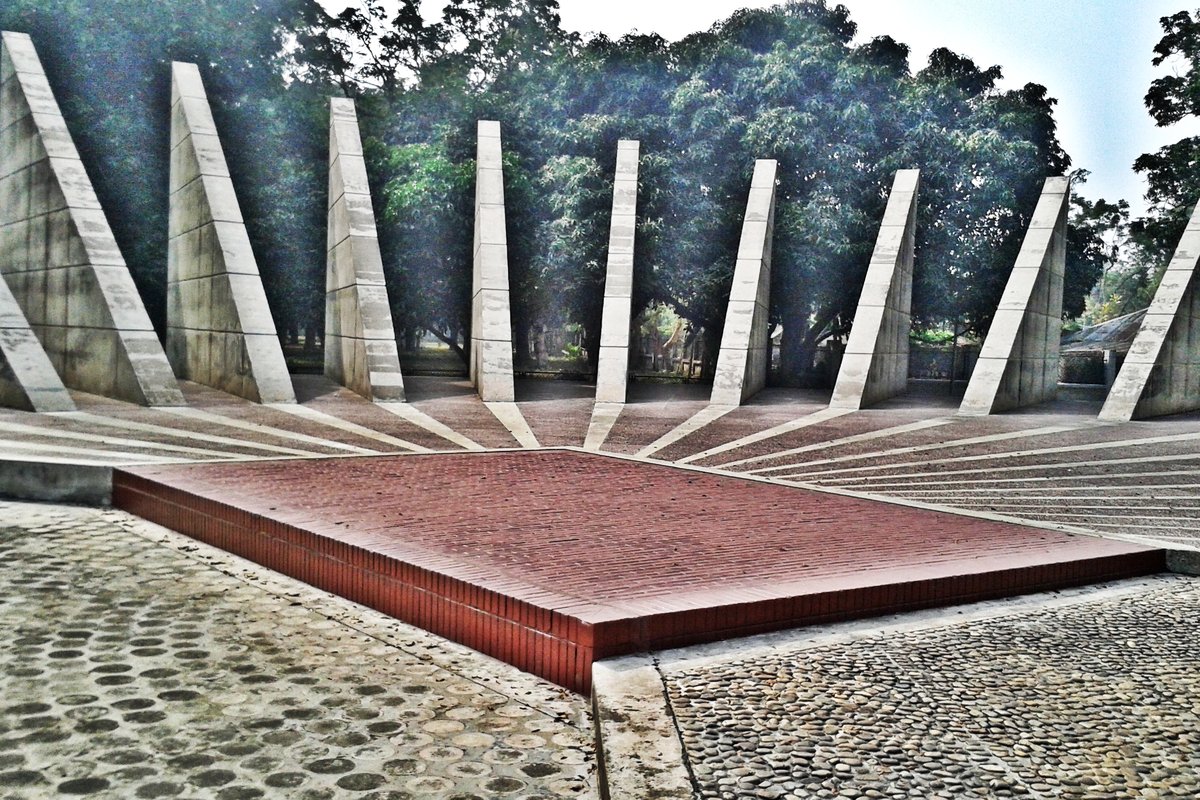
On 17 April 1971, the cabinet took its oath at Baidyanathtala, a village in a mango grove on the border, in what was then Kushtia district and is now Meherpur. It was still Bangladeshi soil, held by Bengali forces and heavily guarded. The national anthem, Amar Sonar Bangla, was sung, the flag was raised, and the proclamation was read aloud by Professor Muhammad Yusuf Ali. Asked by a journalist, Tajuddin named the place Mujibnagar, after the imprisoned leader.
The government's leaders were:
- President: Sheikh Mujibur Rahman (in prison in Pakistan)
- Acting President: Syed Nazrul Islam
- Prime Minister: Tajuddin Ahmad
- Other ministers: Khondaker Mostaq Ahmad (foreign affairs), M. Mansur Ali (finance), A. H. M. Qamaruzzaman
- Commander-in-chief of the armed forces: Colonel M. A. G. Osmani
Fearing a Pakistani raid, the gathering left Mujibnagar quickly. For the rest of the war the government worked in exile from Kolkata, mostly from 8 Theatre Road.
What the government did
The Mujibnagar Government, as it became known, led the liberation struggle. It organized and directed the Mukti Bahini and the new Bangladesh Forces, ran a radio station, Swadhin Bangla Betar Kendra, and even had its own postal service. It worked with India on the war and the refugee crisis, and sent envoys to New Delhi, London, Washington and other capitals to win support for Bangladesh. Many Bengali officials, diplomats and soldiers left Pakistan's service to join it.
Why it matters
The war needed more than courage; it needed a lawful, recognized leadership. Mujibnagar gave the liberation struggle a government, a constitution in miniature and a voice in the world. On 22 December 1971, after the victory, the government came home to Dhaka.
Thanks and sources
Thank you to Wikipedia and its volunteer editors for the information on this page. What you read here is our own summary, based on the Wikipedia articles below. Wikipedia text is shared under the Creative Commons Attribution-ShareAlike 4.0 licence (CC BY-SA 4.0).