Mass uprising
Ayub Khan falls; popular resistance grows.
The case that backfired
In 1968, Ayub Khan's government charged Sheikh Mujibur Rahman and 34 others with conspiring with India to break up Pakistan. It became known as the Agartala Conspiracy Case, after the Indian city where some of the accused were said to have met Indian officials. The government expected the case to discredit Mujib. Instead, for many in East Pakistan, it made him a symbol.
Students lead the way
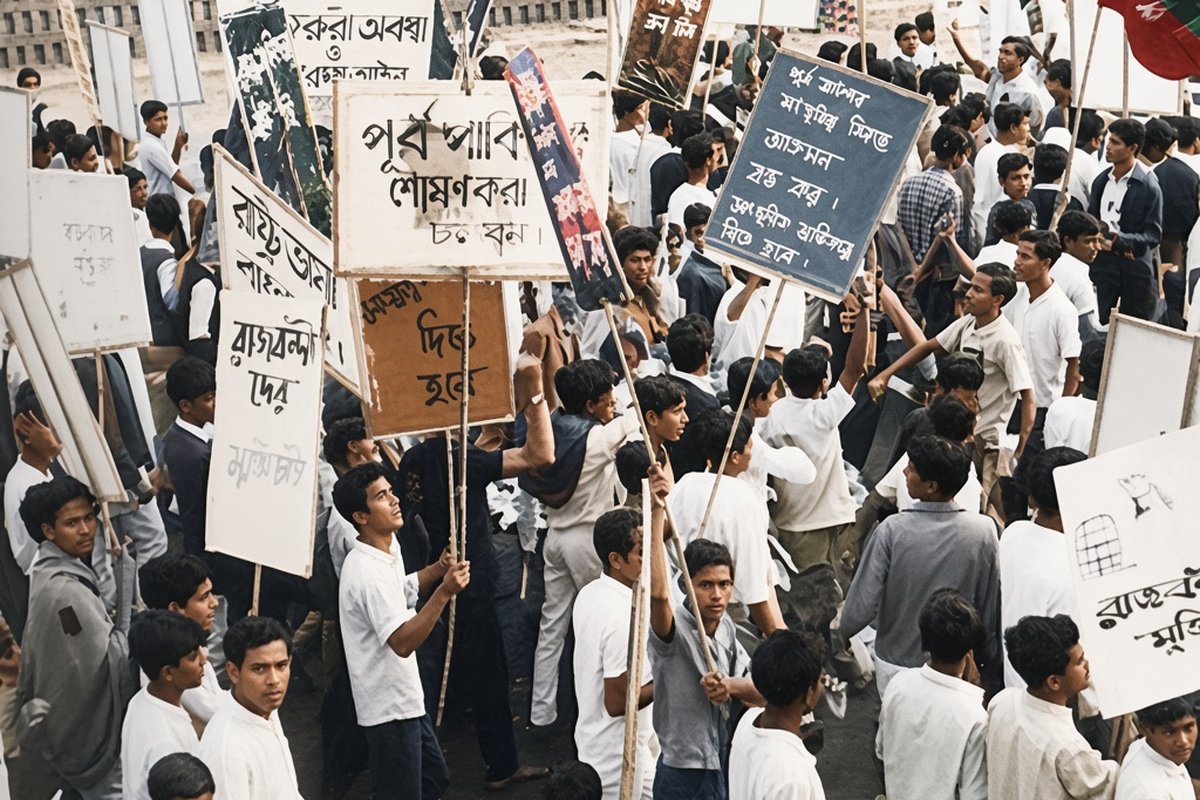
In early January 1969, student groups of different political leanings joined together in an all-party students' action committee and put forward an Eleven-Point programme, built on the Six Points. Opposition parties across Pakistan formed a Democratic Action Committee to demand the return of democracy.
The months that followed were full of strikes, processions and clashes with police. On 20 January, the student leader Amanullah Asaduzzaman was shot dead by police. On 24 January, a teenage schoolboy, Matiur Rahman Mallik, was killed; Bangladesh marks that day as Mass Upsurge Day. In February, Sergeant Zahurul Haq, one of the accused in the Agartala case, was killed in custody, and a university teacher, Shamsuzzoha, was shot in Rajshahi. Each death brought more people onto the streets.
Mujib freed, Ayub gone
On 22 February 1969, the government withdrew the Agartala case and released Sheikh Mujibur Rahman. The next day, at a vast reception in Dhaka, he was given the title Bangabandhu, "Friend of Bengal".
Ayub Khan tried talks with the opposition, but it was too late. On 25 March 1969, he resigned and handed power to the army chief, General Yahya Khan, who imposed martial law again.
Why it matters
The uprising showed that ordinary people, led by students, could bring down a military ruler. It made Sheikh Mujib the undisputed voice of East Pakistan. And within months, the new regime promised what Pakistan had never had: a direct national election, the first in its history.
Thanks and sources
Thank you to Wikipedia and its volunteer editors for the information on this page. What you read here is our own summary, based on the Wikipedia articles below. Wikipedia text is shared under the Creative Commons Attribution-ShareAlike 4.0 licence (CC BY-SA 4.0).