Language Movement
21 February — Students die demanding recognition of Bangla.
The question returns
Four years after the first protests, the language question flared again. On 27 January 1952, Prime Minister Khawaja Nazimuddin, himself from East Bengal, publicly defended the Urdu-only policy. Days later, on 31 January, an all-party action committee was formed at the University of Dhaka, chaired by Maulana Bhashani. It called for strikes and rallies across the province on 21 February.
To stop the protest, the provincial government under chief minister Nurul Amin imposed Section 144 in Dhaka, which banned public gatherings.
21 February 1952
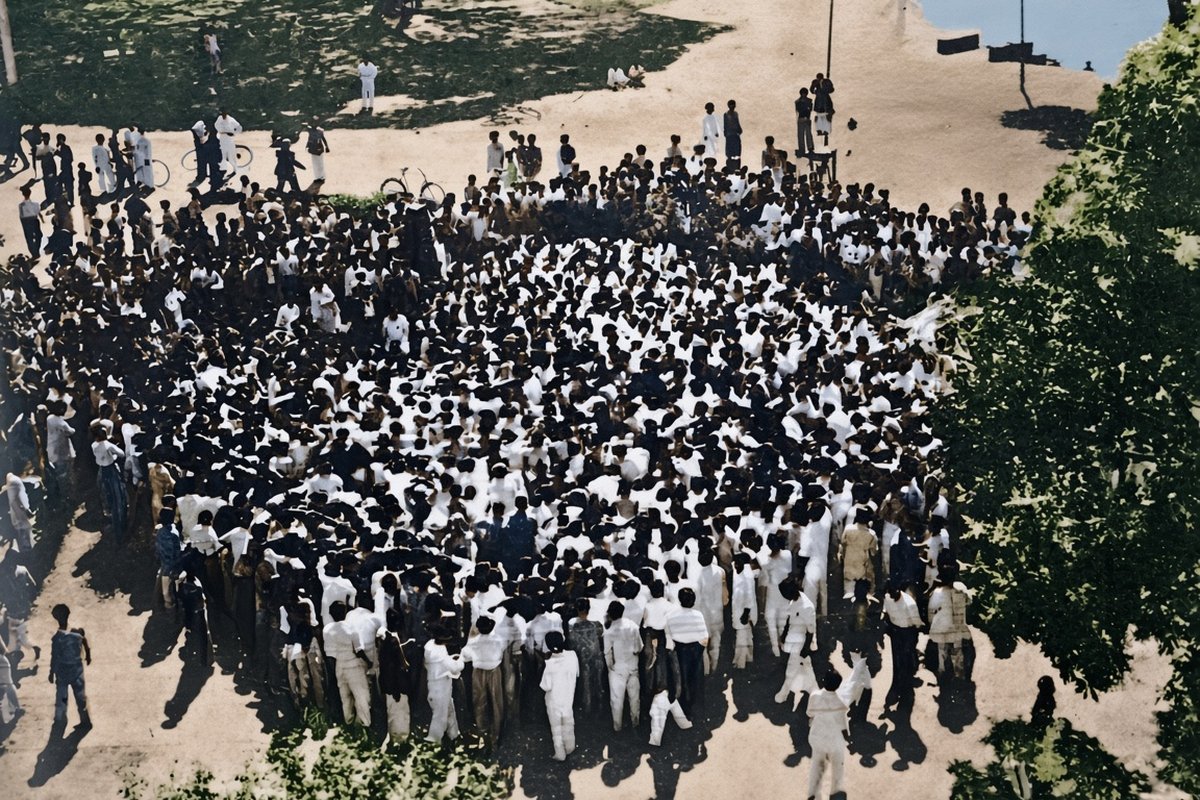
That morning, students gathered on the University of Dhaka grounds in open defiance of the ban, with armed police surrounding the campus. Tear gas was fired, students were arrested, and the crowd moved toward the East Bengal Legislative Assembly to press legislators to take up their demand. Near the assembly, police opened fire.
Among those killed were Abdus Salam, Rafiq Uddin Ahmed, Abul Barkat and Abdul Jabbar. The government's own report admitted three deaths and dozens injured; the true number has never been settled. In the days that followed, police fired again, including on a mourning procession, and more people died, among them the activist Sofiur Rahman and a nine-year-old boy, Ohiullah.
A monument, torn down and raised again
On the night of 23 February, students of Dhaka Medical College built a small memorial to the dead. Police destroyed it within days. A permanent Shaheed Minar, designed by the architect Hamidur Rahman, was finally inaugurated on 21 February 1963 by Abul Barkat's mother. Pakistani forces demolished it in 1971; it was rebuilt after independence.
Why it mattered
The killings turned a debate about language into a question of dignity and belonging. The movement won its point: Bengali was recognized as a state language in 1956. More than that, it gave Bengalis in Pakistan a shared memory and a shared date. Historians on Wikipedia describe it as a forerunner of the Six-Point Movement and, in time, of the war for independence.
The day the world remembers
21 February, Ekushey February, is a national day of mourning and pride in Bangladesh. In 1999, UNESCO declared it International Mother Language Day, so the day students died for Bangla is now marked around the world as a day for every language.
Thanks and sources
Thank you to Wikipedia and its volunteer editors for the information on this page. What you read here is our own summary, based on the Wikipedia articles below. Wikipedia text is shared under the Creative Commons Attribution-ShareAlike 4.0 licence (CC BY-SA 4.0).
- Bengali language movement
- Language Movement Day
- Bangladesh Liberation War (Language controversy section)