General election
Awami League wins an absolute majority in Pakistan's National Assembly.
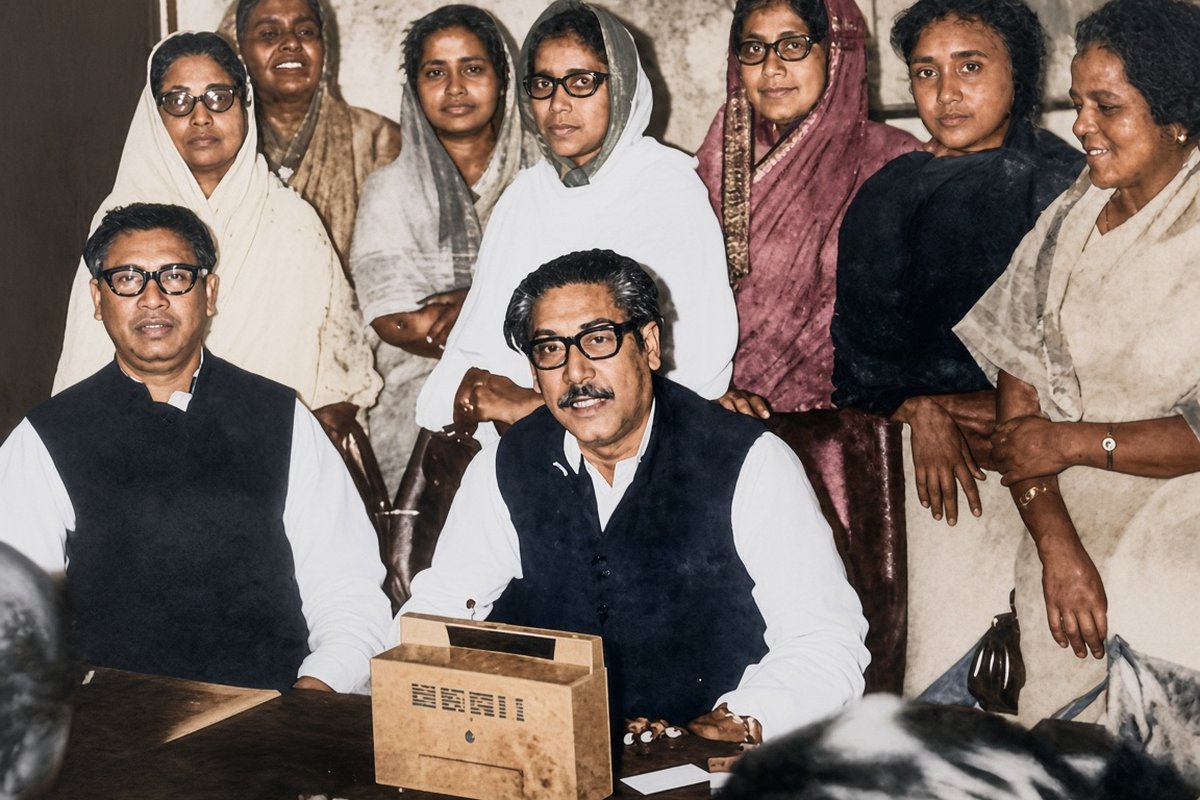
The first real vote
On 7 December 1970, Pakistan held its first direct general election since independence, more than 23 years after the country was born. It would also be the only one held before Bangladesh came into being. Voters chose members for 300 general seats in the National Assembly: 162 in East Pakistan and 138 in the west. Thirteen more seats were reserved for women.
A storm before the vote
A month earlier, on the night of 12 November 1970, the Bhola cyclone struck the coast of East Pakistan. It is counted among the deadliest tropical cyclones ever recorded, with hundreds of thousands of people killed. Many in East Pakistan felt the government in the west had responded slowly and carelessly. That anger went with them to the polls.
A landslide
The Awami League, led by Sheikh Mujibur Rahman and campaigning on the Six Points, won 160 of East Pakistan's 162 general seats and all seven of its women's seats: 167 seats in total, an absolute majority of the 313-member National Assembly. In the west, Zulfikar Ali Bhutto's Pakistan Peoples Party became the largest party, with 81 general seats, but won nothing in the east. Ten days later, the Awami League swept the East Pakistan provincial assembly as well.
By any democratic rule, Sheikh Mujib should now have become prime minister of Pakistan, and the new assembly should have written a constitution, very likely along the lines of the Six Points.
Power withheld
That did not happen. Bhutto refused to accept Mujib as prime minister or the Six Points as the basis for a constitution, and President Yahya Khan delayed calling the assembly. Talks dragged on into early 1971. For the people of East Pakistan, it looked as if they had won the vote and were being denied the result.
Why it matters
The 1970 election gave the Bengali demand for self-rule something it had never had before: an overwhelming, legal mandate. Everything that followed in 1971, the postponed assembly, the non-cooperation movement, the crackdown and the war, grew out of the refusal to honour that mandate.
Thanks and sources
Thank you to Wikipedia and its volunteer editors for the information on this page. What you read here is our own summary, based on the Wikipedia articles below. Wikipedia text is shared under the Creative Commons Attribution-ShareAlike 4.0 licence (CC BY-SA 4.0).
- 1970 Pakistani general election
- Bangladesh Liberation War (Political differences; Response to the 1970 cyclone)
- Non-cooperation movement (1971) (Background section)