Assembly postponed
Yahya Khan halts the National Assembly; East Pakistan answers with non-cooperation.
An assembly that never met
After the 1970 election, the new National Assembly was due to meet in Dhaka on 3 March 1971. Zulfikar Ali Bhutto announced that his party would not attend unless the Awami League gave ground on the Six Points, and warned of protest if the session went ahead without him.
On 1 March 1971, President Yahya Khan announced on the radio that the assembly session was postponed indefinitely.
A city that stopped
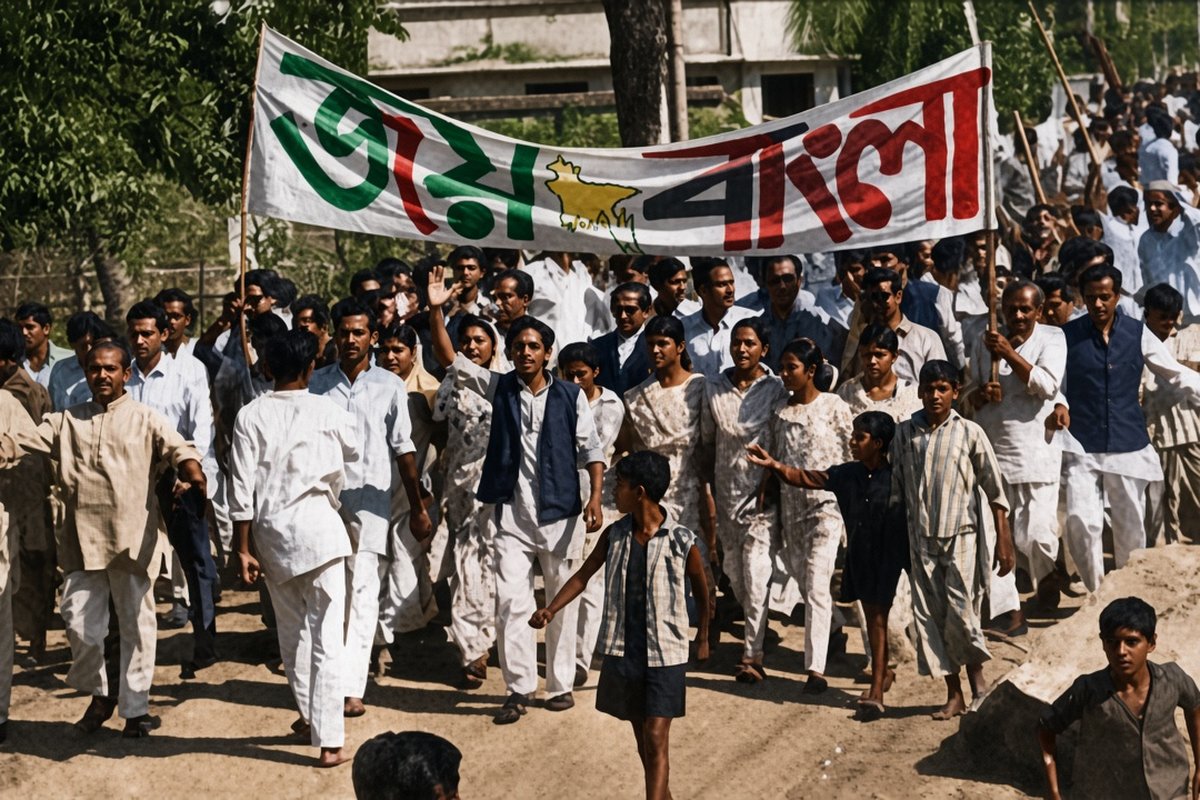
The reaction in Dhaka was immediate. A cricket match at the Dhaka stadium was halted as spectators poured out in protest, and students took to the streets before any party had given the word. The next day, 2 March, Sheikh Mujibur Rahman formally called for non-cooperation with the military government.
What followed was remarkable. For more than three weeks, offices, courts and much of daily administration in East Pakistan answered to Mujib's directives rather than to the central government. Wikipedia describes the province, outside the army's cantonments, as being largely under his authority. People defied curfews. In Chittagong, port workers refused to unload weapons from a Pakistani ship, the MV Swat.
A tense and violent month
The weeks were not peaceful. Security forces fired on unarmed protesters in several towns, killing many. There was also violence by Bengali crowds against Urdu-speaking Bihari residents, especially in Chittagong, which the military later used to justify its crackdown. Meanwhile, Yahya Khan came to Dhaka for talks with Mujib from mid-March, joined by Bhutto, even as troops and arms were quietly being flown in from the west.
Why it matters
The postponement turned an election victory into a confrontation. In the space of a few days, East Pakistan showed that it could, in practice, govern itself. The non-cooperation movement lasted from 2 to 25 March, ending only when the army struck on the night of Operation Searchlight.
Thanks and sources
Thank you to Wikipedia and its volunteer editors for the information on this page. What you read here is our own summary, based on the Wikipedia articles below. Wikipedia text is shared under the Creative Commons Attribution-ShareAlike 4.0 licence (CC BY-SA 4.0).
- Non-cooperation movement (1971)
- Provisional Government of Bangladesh (Background section)
- Timeline of the Bangladesh Liberation War
- Operation Searchlight (Background section)