Six-Point Movement
Sheikh Mujibur Rahman demands autonomy for East Pakistan.
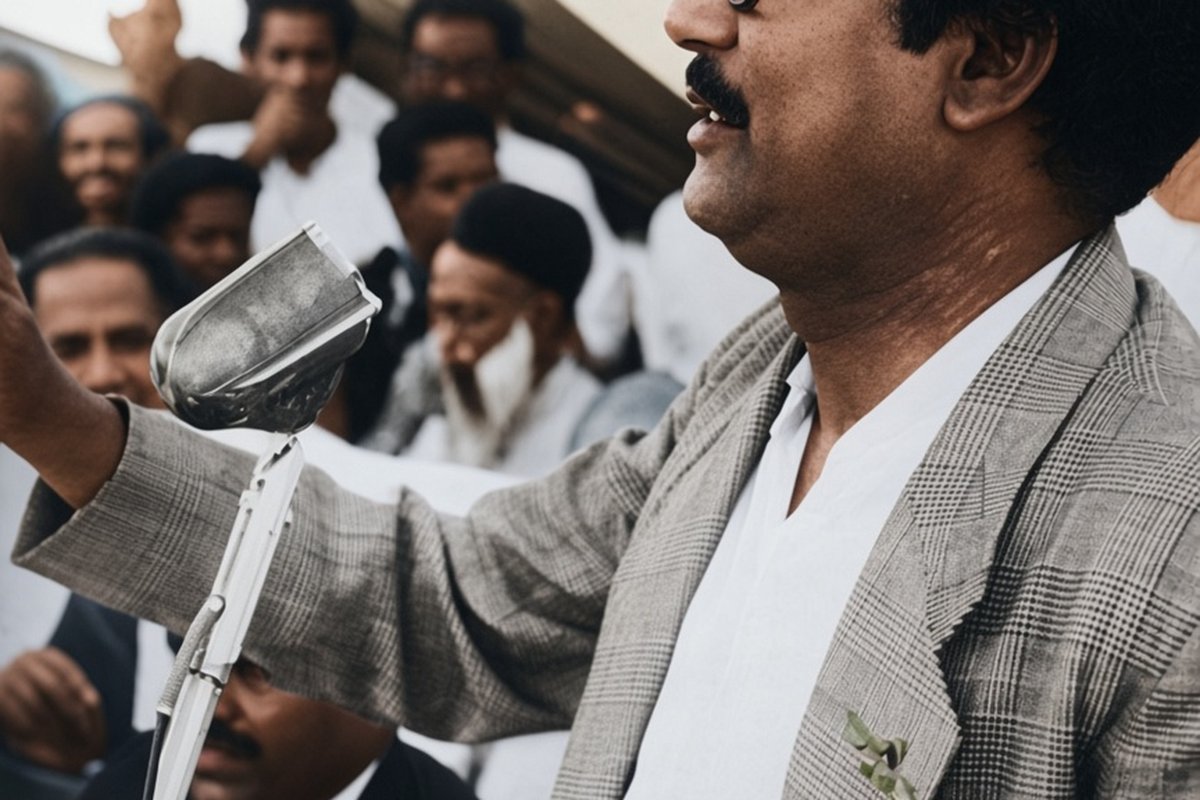
Lahore, February 1966
After the 1965 war with India, opposition leaders across Pakistan met in Lahore to talk about the country's direction. Sheikh Mujibur Rahman, of the Awami League, arrived with a short, bold proposal for East Pakistan. On 5 February 1966, he asked for it to be put on the conference agenda. It was refused, and he was labelled a separatist. He walked out.
Back home, on 21 February 1966, the anniversary of the 1952 killings, the Awami League's working committee adopted the proposal unanimously. It became known as the Six Points.
What the six points asked for
In plain terms, the Six Points imagined Pakistan as a true federation:
- A parliamentary government, elected directly by all adults.
- A central government limited to defence and foreign affairs.
- Separate currencies for the two wings, or firm safeguards to stop money draining from east to west.
- Taxes collected by the provinces, not the centre.
- Separate foreign-exchange accounts for each wing, and the right to make trade links abroad.
- A militia or paramilitary force for East Pakistan.
Behind these demands were years of numbers: East Pakistan's jute earned much of the country's export income, but people in the east felt that the money, the jobs and the decisions stayed in the west. Economists and thinkers such as Rehman Sobhan and Nurul Islam helped shape the programme.
Rejected, and then embraced
Politicians in West Pakistan rejected the Six Points, as did several parties in the east. Ayub Khan's government saw them as a threat to the state. Sheikh Mujib spent much of the following years in jail, and in 1968 he was made the main accused in the Agartala Conspiracy Case.
Yet the Six Points won wide support among ordinary people in East Pakistan. They became, in effect, the Awami League's charter, and the programme it carried into the 1970 election.
Why it matters
The Six Points did not call for independence. They called for a Pakistan where East Pakistan could govern itself. Wikipedia describes the movement as a crucial milestone on the path to Bangladesh. When Pakistan's rulers later refused to let an assembly write a constitution along these lines, the road towards separation opened.
Thanks and sources
Thank you to Wikipedia and its volunteer editors for the information on this page. What you read here is our own summary, based on the Wikipedia articles below. Wikipedia text is shared under the Creative Commons Attribution-ShareAlike 4.0 licence (CC BY-SA 4.0).
- Six Point program (the article "Six point movement" redirects here)
- Agartala Conspiracy Case
- 7 March Speech of Sheikh Mujibur Rahman (Background section)